
Grant County Criminal Docket Searches
New Mexico Case Lookup is the free starting point for a Grant County criminal docket search. No account is required. It returns public case-level information drawn from district, magistrate, and limited municipal records. It is not a document room, though. Use the exact case number when a notice or earlier result gives you one. Without a number, search the party name. Pick the court and location the interface offers, and narrow the filing year. Before trusting a result, check the case style. Then check the location, type, filed date, and judicial officer against what you know.
A Grant County search without a case number takes extra care. One incident can pass through more than one court level. A felony that began with a first appearance or preliminary hearing may show events in both the magistrate and district files. Compare them. An empty municipal result does not prove the city filed nothing. The Grant County public index covers only limited municipal courts. Once a result matches, save the case number. That number is the best key for a clerk request, a hearing check, or any later docket search.
- Open Case Lookup and select the court and Grant-area location shown by the portal.
- Enter the exact case number, or use a legal name with a filing-year limit.
- Confirm the court, case type, filing date, and location in the results before opening a case detail.
- Read hearings, events, charge text, status, and financial entries as separate fields rather than as one conclusion.
- Use the filing court clerk or the state IPRA route for an eligible copy, certified record, or an event that is not online.
The New Mexico criminal forms index lists the official form families used in criminal workflows.
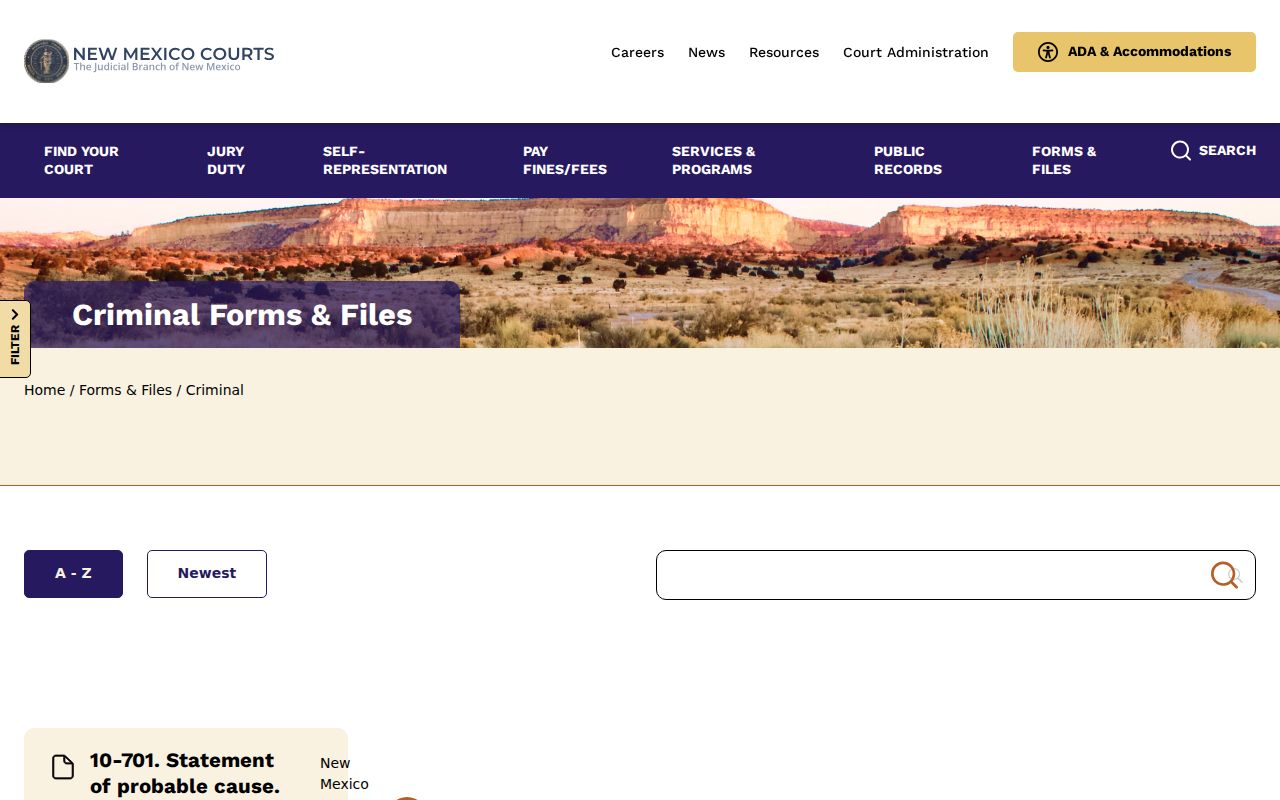
Those forms can decode unfamiliar terms. Still, a blank state form does not prove any Grant County criminal docket actually contains it.
Grant County Criminal Docket Court Routing
Routing for a Grant County criminal docket depends on which court filed it. The Sixth Judicial District Court sits in Silver City. It handles felonies and other matters assigned to district court. Grant Magistrate Division I sits in Silver City. Division II sits in Bayard. They take listed misdemeanors, DWI/DUI, traffic cases, and felony first appearances or preliminary hearings. A city municipal court keeps its own petty-misdemeanor, DWI/DUI, traffic, and ordinance file. Whichever court appears in the result controls your next request.
For an in-person Grant County case-record question, contact the filing court directly. The recorder's office is the wrong stop just because the case arose in the county. The district counter sits at 201 N. Cooper Street, Silver City. The main phone is 575-538-3250. Magistrate Division I is at 214 N. Black Street, Silver City, 575-538-3811. Division II is at 701 Central Avenue, Bayard, 575-537-3042. The district location page advises confirming counter procedures before you travel. City matters should start with the issuing city court.
District criminal files
Grant County District Court
201 N. Cooper St., Silver City, NM 88061
575-538-3250
Magistrate criminal files
Division I: 214 N. Black St., Silver City
575-538-3811
Division II: 701 Central Ave., Bayard
575-537-3042
The Sixth District courtroom rules provide the official visitor guidance for court proceedings.
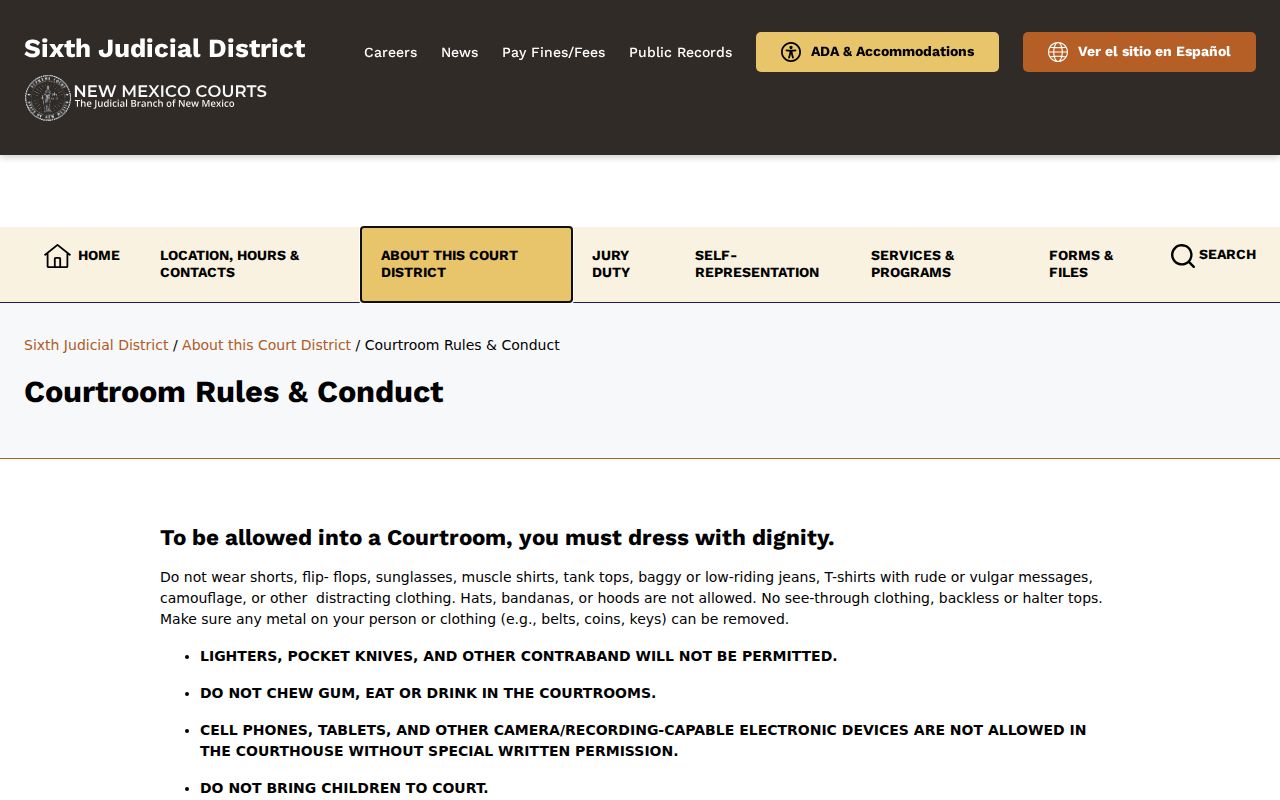
Let the actual court notice govern security and device rules. That matters most when a criminal docket lists a remote or hybrid setting.
Criminal Dockets: What They Show
A Grant County criminal docket is a chronology rather than a single verdict label. Public case detail can show a number, type, charge information, filed date, judicial officer, location, status, hearing fields, and a warrant flag when the system makes those fields public. The register of events supplies the sequence. A document link in registered re:SearchNM access depends on the account profile, so a missing link in Case Lookup does not mean nothing was filed.
Read each Grant County result field by field. A charge stays an allegation unless the displayed disposition says otherwise. A balance records financial activity, not a legal outcome. Confirm any warrant indicator with the court rather than treating it as a current-status finding.
| Case number | Use the court-assigned identifier, such as court / location / category / year / number, exactly as the public result displays it. |
|---|---|
| Charge and dates | Keep recorded charge text separate from the charge date and the case filing date. |
| Hearing event | Shows a scheduled or completed proceeding, such as an arraignment, preliminary hearing, plea, trial, or review. |
| Plea and disposition | Use the exact public entry. A plea, disposition, and sentence are related but distinct fields. |
| Financial detail | Assessment, payment, credit, balance, and receipt activity are separate entries from the legal result. |
Grant County Criminal Docket Event Terms
Grant County court materials call the chronological record by the New Mexico terms "events" and "filings." Trust the public description shown. Do not guess a code definition. A date beside an event may reflect filing, hearing, order entry, or payment. Keep the text as written. Let the event sequence supply the context. A future setting is not a disposition. And "closed" is a system status that can cover more than one legal outcome.
- Arraignment
- A proceeding where charges are addressed and a plea or next step may be taken.
- Preliminary hearing
- A probable-cause proceeding in an eligible felony matter, often associated with the magistrate stage.
- Continuance
- A postponement of a proceeding. It does not resolve the case.
- Disposition
- The recorded result category for a charge, claim, or case event. Read its exact text.
- Warrant flag
- A public-system indicator that requires direct confirmation from the court.
Note: When building a Grant County criminal docket timeline, keep a hearing date, an order date, and a payment date separate.
Criminal Case Stages on the Docket
A Grant County criminal timeline can cross court levels. A felony may show an early magistrate event. The district file picks up later proceedings. Misdemeanor, DWI/DUI, traffic, and city-ordinance matters can stay entirely within a magistrate or municipal court. So read the Grant County public docket as a sequence. It runs by the displayed court and case number. It is not an all-purpose account of a single incident.
Docket flow: Filing or charge → first appearance or arraignment → preliminary or pretrial setting → plea or trial → disposition → sentence or later financial event.
A plea entry on a Grant County docket is not a sentence entry. The two answer different questions. A disposition can close a charge on the record while later orders never appear. Payment lines often land after the legal side ends. Need a judgment and sentence, a named order, a transcript, or a certified copy? Order from the court rather than the docket view.
The Sixth District pretrial-services material lays out a local program that eligible Grant County cases may pass through.
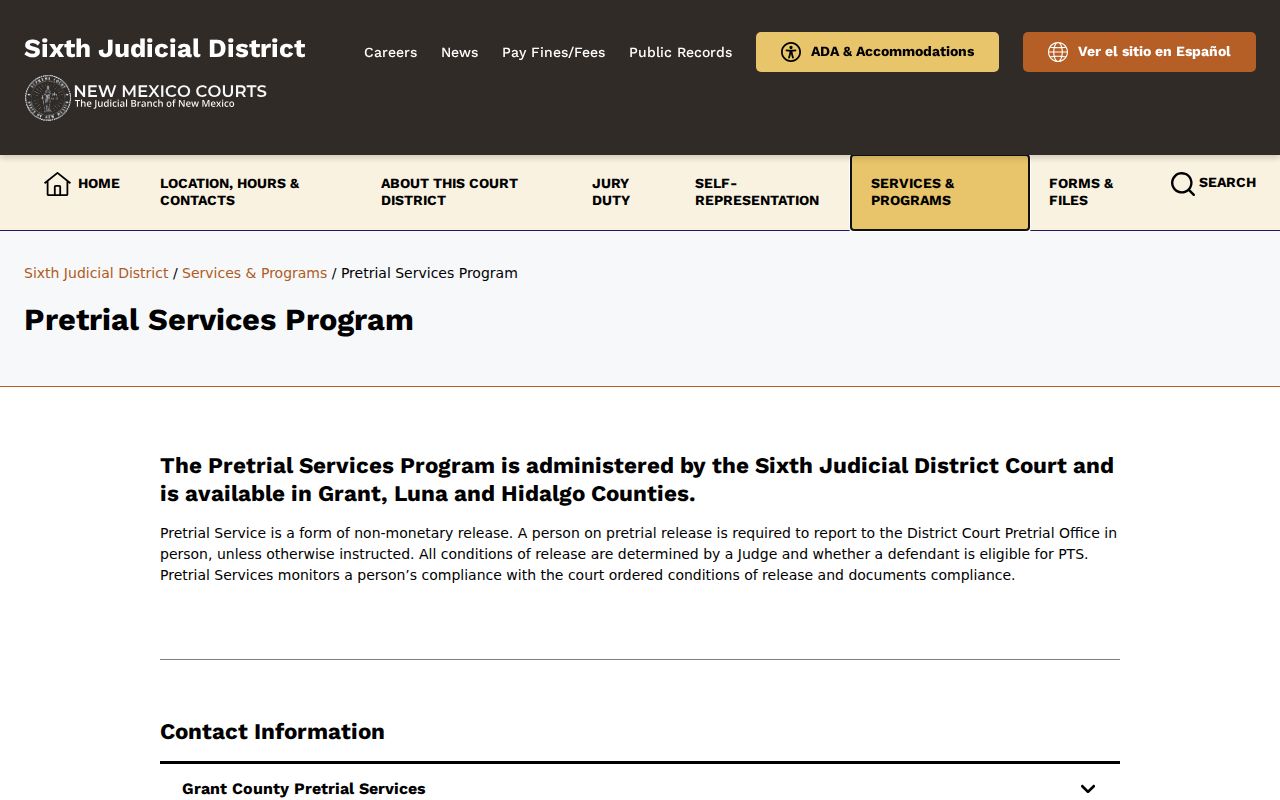
Program pages give court-system context, not case answers. The docket entry itself governs any particular Grant County hearing, order, or outcome.
Note: Keep each Grant County criminal docket stage separate: charge, hearing, disposition, sentence, and later money events each carry their own dated entry.
Grant County Criminal Docket Warrant Flags
Treat a warrant flag as one field. A Grant County criminal docket may show failure-to-appear or warrant events, and a flag is only the portal text at that moment. Later entries can cancel it, quash it, set a hearing, or log an administrative update. So a flag alone is never the current warrant determination. Read nothing beyond its exact wording.
The practical move is simple. Save the case number. Identify the filing court. Then ask that court directly about the current record and any appearance instructions.
Verification point: A warrant flag or failure-to-appear entry needs confirmation from the filing court because later events may change its meaning or status.
Grant County district and magistrate main numbers are public. The official pages stop short of a general docket-clerk extension for every event type. Ask whoever answers to route you to the records, criminal, or court counter desk. A phone answer confirms routing, nothing more. It is not a certified record.
Grant County Criminal Docket Courts
Grant County criminal records sit in several places. The District Court holds the district criminal file. Grant Magistrate Division I and Division II each keep their own limited-jurisdiction case records. Bayard, Hurley, Santa Clara, and Silver City municipal courts keep separate municipal files. That split explains a blank Case Lookup result. It also explains a notice naming a city court. A county-recorder search is no stand-in for a criminal docket search, since recorded instruments and state court files live with different custodians.
Municipal coverage is thin in the Grant County public statewide index. Per the public access material, municipal entries cover only criminal domestic-violence and historic DWI convictions. Those entries begin September 1, 1991. Any other Grant County municipal matter belongs with the issuing city court. For a state criminal case missing online, check the district or magistrate court first. Then use the clerk or IPRA path.
Note: The displayed court and the exact case number, not a party name alone, are what finally route a Grant County criminal records request. A party name alone will not do it.
Grant County Criminal Docket Document Access
New Mexico's public-access guidance separates two layers for Grant County results. One is the free Case Lookup index. The other is registered re:SearchNM access. Case Lookup shows no documents. It also hides exposed personal identifiers. Re:SearchNM carries broader case and document detail for users whose profile permits it. Its user guide covers searches by case number, category, type, status, filing date, judge, location, party, attorney, filings, and hearings. A missing document can trace to security, redaction, sealing, or an access limitation.
An eligible Grant County record is not always online. In that case, request it from the filing court. In person, state the court, the case number, the record type, and whether you need a certified copy. The court IPRA form lets you pick Sixth Judicial District and the specific court. Then describe the record. For a criminal case, name the item precisely. Options include a criminal complaint, judgment and sentence, docket or event history, a date-bounded order, or a financial record. The County Clerk recorder form handles recorded instruments, not these court files.
Need the right number or court? Use the Grant County docket search to compare the public-index and registered-search layers.
Access Rules for Criminal Dockets
Three things shape public access to Grant County criminal records: Rule 1-079 NMRA, the state online-access policy, and individual court orders. Case Lookup hides juvenile criminal cases after July 1, 2007. It also hides Family Violence Protection Act order-of-protection cases after July 1, 2008. Sealed, expunged, confidential, or otherwise protected material may be absent, limited, or open only under a permitted profile. The public index supplies no court documents at all.
Call a vanished Grant County result what it is. Use restricted, not displayed, or not located, and only when the court or portal supports that wording. A missing entry is not evidence of dismissal, acquittal, expungement, or nonexistence. A clerk can walk you through inspection, copies, certification, transcripts, or a court-order process for an eligible file. The clerk cannot give legal advice. Nor can the clerk bypass a restriction.
Access rules: The court IPRA request route says a written request must include contact information and reasonably describe the records. The request need not state a reason, but it must go to the record’s actual custodian.
Grant County Criminal Docket Expungement Limits
Expungement changes what eligible Grant County criminal records the public can see. It does not equal other case outcomes. The exact event text still controls what the docket says. A public researcher should not rebuild a withheld record from unofficial sources or read an access limit as proof about the underlying matter. The record worth using is the one the court itself releases. Use its stated channels. Respect the restrictions.
The New Mexico Judiciary's expungement information explains the state process and how it affects public access.
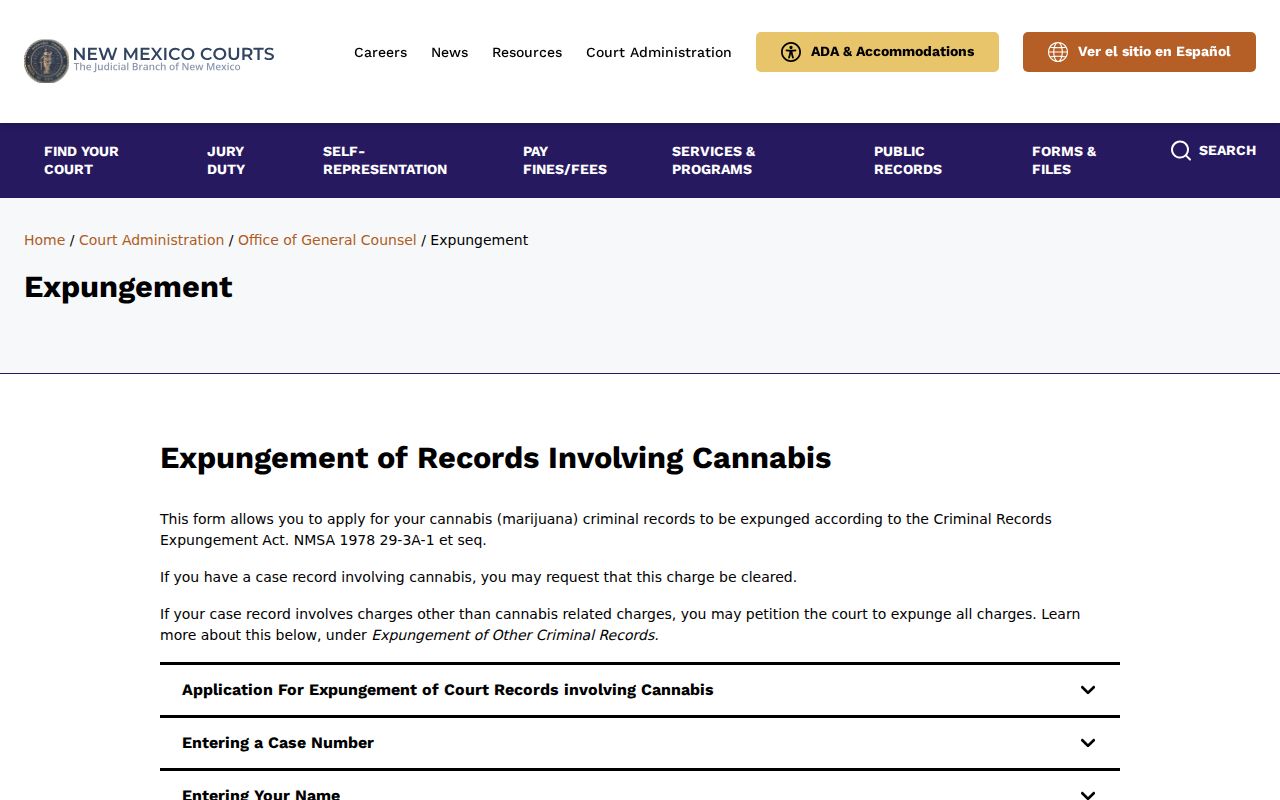
A restricted entry on a Grant County criminal docket means the court has capped what the public can see. The right move is simple. Follow the court's access rule. Then ask the clerk about the proper route for an eligible request. An access restriction only marks a limit on public visibility, so it tells you nothing about where the underlying criminal case stands.