
Name-Based Case Searches
For a Grant County name search, the public starting point is New Mexico Case Lookup. Type the legal last name and first name first. Then narrow by court, county or city location. Use a filing-year range where the interface offers that choice. Run a broad name alone and you may pull up lookalike parties or cases from other New Mexico locations. Before calling a result a match, check the case style, case type, filing date, court, and judicial officer.
- Choose the court level named on a notice, if known.
- Enter the party name and use the location and year fields to narrow the Grant County result set.
- Open the case detail and preserve the exact case number, court, and filed date.
- Check the public event language without turning a status label into a legal conclusion.
- Use the filing clerk if the identified case is missing a needed record or setting.
Only after a focused search fails should you try alternate spellings, initials, or punctuation. Personal identifiers, including Social Security numbers and address information, never appear in Case Lookup. A narrow, court-specific query works better. It also stays inside the system's public access boundaries.
Grant County Court Selection
A Grant County search has to tell apart the Sixth Judicial District Court, Grant Magistrate Division I in Silver City, and Grant Magistrate Division II in Bayard. It also covers four city municipal courts. The same event can sit at different court levels at different stages. A felony might carry a magistrate first appearance or preliminary matter plus a district case. A city ordinance or traffic citation can stay with the municipal court. For routing, trust the court label and case number. Do not trust a city name alone.
Case Lookup's municipal coverage is narrow. It lists the categories the judiciary identifies, not a full municipal docket or every citation. A blank municipal search means you should call the issuing city court. For district and magistrate cases, start with the statewide index. Then go to the exact Sixth District counter or file the court IPRA request form for a specific record.
Case Number Searches
For a Grant County search, an exact number usually beats every other term. New Mexico's public instructions show a structured example built from court, location, category, year, and case number. Treat that example as a format illustration only. It is not a Grant prefix to guess. Pick the court and location the live portal offers. Then enter the number from the citation, notice, or a prior official result. Keep the returned spelling and punctuation even when the system tolerates looser queries.
Never recast a common sample as a real local number. Missing the precise number? Search by party name with a date range instead. Once a result appears, save it in a form such as [official court / location / category / year / number]. Do not invent a code. In a regional judicial district, the portal's court and location fields carry extra weight.
Grant County Search Fields
The public index and registered re:SearchNM draw on related but different fields. Case Lookup handles court, location, category, year, case number, and party-oriented searching. Registered re:SearchNM adds more fields. These include case category or type, status, filing date, judge, attorney, filings, hearings, financial information, and business-name searches. Those extra fields can shrink a large result set. Still, they cannot override the court's online-access limits.
| Field | Use in a Grant County search | Care point |
|---|---|---|
| Court and location | Separate district, magistrate, and municipal routes. | Do not assume a city name identifies the filing court. |
| Case number | Anchor an exact result and clerk request. | Preserve the official returned text. |
| Party and filing date | Narrow a name search. | Confirm case style and court before relying on it. |
| Hearing date or type | Find a setting through registered fields. | A setting is not a disposition. |
| Filing or event | Read activity in sequence. | Document access can remain restricted. |
The Grant County Clerk page shows that the county recorder and the state court clerks keep different records. Knowing that split saves you a dead-end trip to the wrong office.
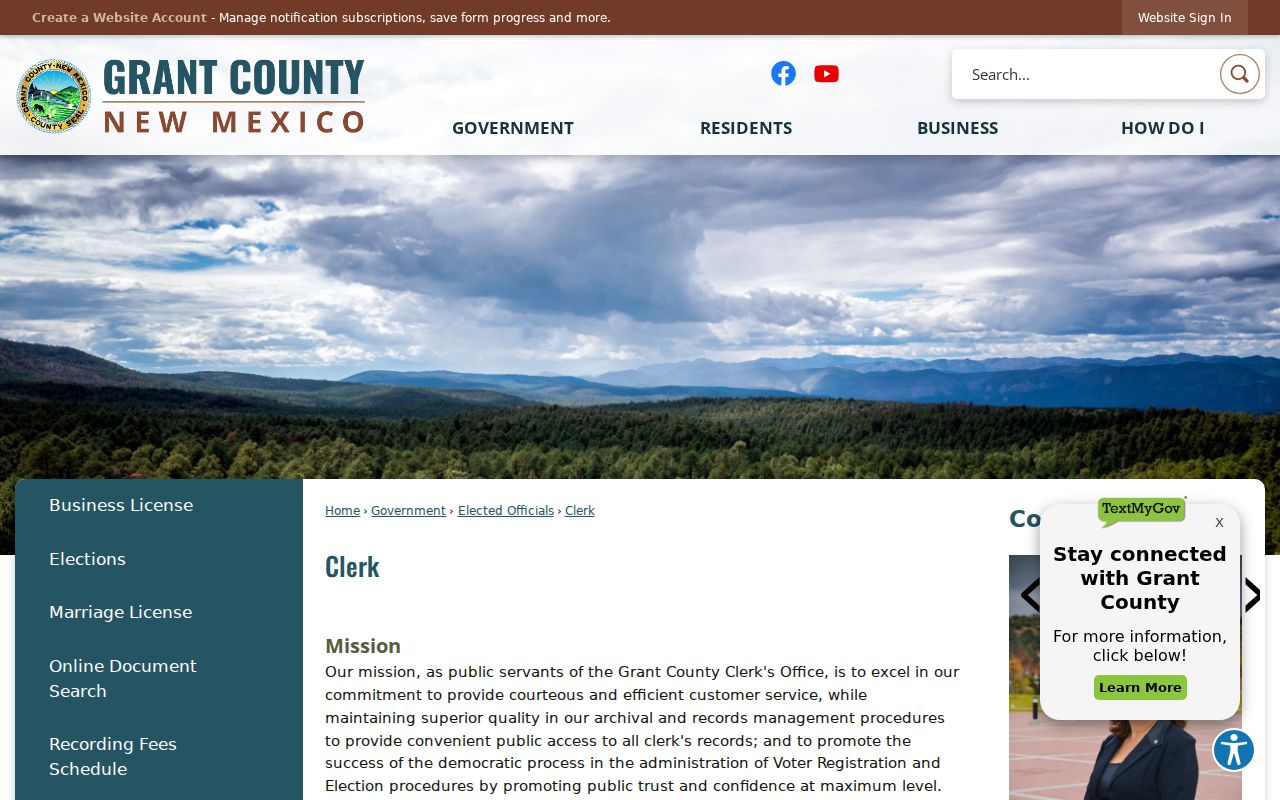
The county page supports the custodian distinction. It does not replace the search path for a Sixth District case.
Case Search Results Explained
A public case detail can list a number, caption or style, type, charge or claim category, filed date, court location, judicial officer, status, selected hearing fields, and a warrant indicator when displayed. It may also open a register of actions or events. Read those events in order. A notice of hearing sets a future date. An order is judicial action. A payment is a financial entry. A closed label is a system status, not a full explanation.
| Case style | Public title used to distinguish the matter from similarly named results. |
|---|---|
| Filing date | Case start date, not necessarily an event or outcome date. |
| Event description | Exact public language for a filing, hearing, order, payment, or administrative change. |
| Hearing | Date, type, location, and judicial officer when the public system shows them. |
| Document link | May require an authorized re:SearchNM profile and is not proof that a missing document was never filed. |
"Closed" can sit beside a later payment entry. Read "Disposition" in its displayed language and date. A public result stays an index-level view, not an invitation to infer private facts or a person's present legal status.
Grant County Event Reading
Grant County docket entries read most clearly in five groups: pleadings or filings, hearings and settings, orders or judgments, and criminal pleas or dispositions. A fifth group holds financial or administrative events. A hearing row can be timely and still say nothing about the outcome. A warrant flag is a court-system indicator that needs confirmation with the court. Never recast it as a current status claim.
- Register of Actions
- The chronological list of court events and filings.
- Filing date
- The date a case or document entered the court system.
- Disposition
- The recorded outcome category, which should remain in its exact text.
- Continuance
- A postponement or extension of a setting.
Note: Alongside an event sequence, jot down the date you checked the portal, because Odyssey data can shift as filings and payments synchronize.
Two Ways to Search: County and State
Searchers in Grant County have two main layers, and each answers a different question. Case Lookup suits quick public checks. It shows selected case fields. It works best when you already hold an exact court number. Registered users get more from re:SearchNM. That is the statewide layer for broader eligible case and document material. For inspection or certified copies, go through the local court itself. Grant County adds no county-wide state-court docket portal of its own. None sits on top of these systems.
| Channel | Best use | Limit |
|---|---|---|
| Case Lookup | Public case discovery by court, name, or number | No documents and limited municipal scope |
| re:SearchNM | Eligible registered case, filing, and hearing searches | Profile and security controls apply |
| Sixth District calendar | Current day plus six future days | Not a full history or long-range calendar |
| Filing clerk or IPRA | Inspection, targeted records, and certified copies | Requests must name the actual custodian and item |
A court date usually takes just the short schedule plus the notice. Digging for a full event sequence or a document is different. There, an identified case number makes a clerk request far more workable.
Grant County Hearing Searches
The Sixth District public docket pages are built around dates, not long historical search forms. You pick a schedule, then a day. Separate pages cover the Grant district court, Silver City magistrate, and Bayard magistrate. Each spans the current day plus six days. Registered re:SearchNM goes deeper on hearings. It lists case number, status, type, hearing date and type, judge, location, party, attorney, and CAID. Whatever the calendar shows, the notice still controls when you must appear.
A missing hearing on the short calendar has several possible explanations. The setting may fall outside the published window. It may sit in a different court. It may be withheld under an access rule. Call the filing court to sort it out. Say whether you need the next setting, a past event, a copy, or a certified record. Each is a different product with its own procedure.
Grant County Clerk Fallbacks
If a public search returns nothing for a Grant County case, the court type tells you who to call. The District Court main line is 575-538-3250. Magistrate Division I is 575-538-3811. Magistrate Division II is 575-537-3042. A city citation belongs with the municipal court that issued it. State court staff can point you to the right records or calendar desk. But a phone answer is never a certified record.
Before calling, gather the party name, the court, an approximate filing year, and any case number you have. When a document is missing from an eligible state case, put the exact court on the IPRA form. Name the record you want. The County Clerk recorder handles recorded instruments. That is a separate route entirely.
Which Cases Stay Restricted
New Mexico's public index does not mirror every court file. The judiciary says plainly that documents are not available through Case Lookup. Juvenile criminal cases dropped out of the public index in 2007, and Family Violence Protection Act order-of-protection cases dropped out in 2008. Municipal coverage runs only to the categories the judiciary describes, among them criminal domestic-violence matters and historic DWI convictions beginning in 1991. Sealed, expunged, confidential, and protected material may be absent or restricted as well.
Rule 1-079 NMRA provides the public-access framework for court records and protected identifiers. If an eligible record is not publicly displayed, use the exact court selection on the IPRA form and request a specific item. The clerk can explain whether a redaction, inspection, plain copy, certification, or court order applies.
Describe a blank result as not located in the public index. That is all it means. It is not proof the case never existed, nor evidence of dismissal, expungement, or any other conclusion.